
INTERVIEW WITH MEKY OTTAWA
January 24, 2021 – Zab Cafe
INTERVIEW WITH MEKY OTTAWA
Meky, tell us about yourself and your artistic journey.
I’m Meky Ottawa. I’m Atikamekw from Manawan and I’m a multidisciplinary artist. My journey started when I was really young; my mother had a camera and I made films with my cousins. We made horror movies! Also, when I was 5, my mother signed me up to be an extra in a Hollywood film that was shot here in Montreal: Grey Owl. The actor Pierce Brosnan was in it —we called him James Bond! That’s really when I got interested in film, then in the arts, and today I do a bit of everything. My mother influenced me a lot because she also worked with a camera. It’s as if she knew I was going to be an artist. When I was 13, my father bought me a guitar, and I didn’t even know I wanted a guitar! Ha ha! And in the end I learned to play! I’ve always been very curious and I like to try everything. Recently, I bought myself a tattoo machine to create with. I’m self-taught. I didn’t go to university; school wasn’t for me. I learned everything on the job, and I’ve always played and I love to play. That’s what work is, for me.
How would you define your style, and where do you find your inspiration?
I really like humour, dark humour. My style comes from my village, Manawan. It’s modern and traditional, and very colourful. I love colours. They give a lot of energy, and each colour I use has a specific meaning. Colour is a very powerful language.
Do you use art in a socially engaged way?
I think people tend to look at my work as if I were making a statement… It’s really important to say what you think these days. When you’re an Indigenous artist, you’re an activist or an ambassador for your culture, because there aren’t many of us. We’re a small percentage of artists. We’re the representatives and the voice of our cultures.
In your view, what reach can art have?
For me, art is a message I send out, and people will interpret it however they want. I like mystery. Art is also a way to show that we are here. A Chilean poet once told me: “Art is very important for Indigenous people, because it is the language that will allow us to build a bridge with non-Indigenous people. Art is more peaceful, and people tend to listen more through art; that’s how we’ll charm them, and once we’ve charmed them, they’ll have bigger ears.” Art connects people. Art is important for living. What would the world have become without art? It’s important for our survival.
What do you find most distressing or infuriating about recent events and the systemic racism that persists and still isn’t acknowledged?
It’s very hard… What makes me angriest is that whatever we do, we’re fucked anyways. I try not to be angry because it eats away at you and makes you age faster. But it’s blatant, it’s in everyone’s face, and it [the government] says nothing. The way it [the government] handles things is toxic; the actions are very different from the words. The people who hurt Joyce, where are they right now? Sometimes I get discouraged, and other times I tell myself, “yay! There are allies everywhere!” We don’t always know they’re there, but they are!
We also need to change the history books and tell the real story!
Are your parents defenders of Atikamekw cultural traditions?
Yes. Both my parents work for the CNA, the Atikamekw Nation Council*. My mother is deputy negotiator; she protects the territories and negotiates, and my father maps the ancestral family territories of Indigenous people. He traces all the places on maps. My parents are —and my grandparents were too— activists and people who believe in us and want to protect [our culture]. We’re trying to show that to my niece, my nephew and the kids around us too. My mother always says it’s now our turn to speak up.
Is there an aspect of your culture that makes you proud?
I really love speaking Atikamekw. It makes me very proud. I’m also proud that there’s an awakening and that people are more curious about Indigenous peoples. Seeing that there are allies, people coming together, I find that beautiful.
Is there an Atikamekw artist you particularly admire?
Yes, but he isn’t well known. His name is Atos. He’s an incredible guitarist. I always tell him that the day he sells tickets for a concert, it will be sold out in 30 seconds! I’ve already used his music in one of my videos. He doesn’t have an album, but he plays like a rockstar!
What motivated you to do this collab with us?
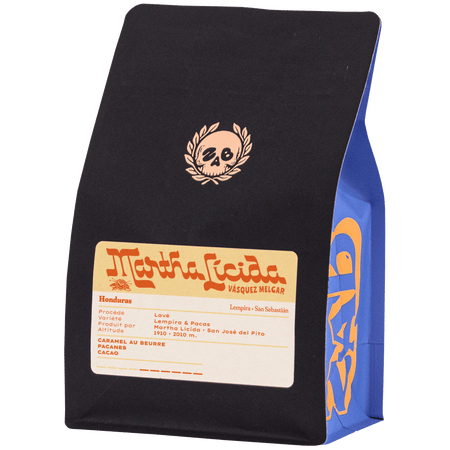
I love doing branding and graphic design. And I love coffee! That comes from my father; we’re coffee drinkers in my family! And when you told me about the project (giving part of the profits to an organization), I jumped on board right away. I already had the Iskweu organization in mind!
We asked you to choose an organization to receive part of the profits from the sale of the bags we created for this collaboration. You chose Iskweu, an initiative of the Native Women’s Shelter of Montreal that supports families when an Indigenous woman or girl goes missing. Why?
I find this organization does important things and I like to help when I can. It’s a small gesture. What troubles me is how MMIW (Murdered and Missing Indigenous Women)** disappear in silence, before the eyes of people in uniform that the government manages, as well as the violence and discrimination [committed by] police services. Women who denounce abuses of power by police officers are publicly shamed. It’s very easy to control other people’s image when you have power, the tools and friends. And when the government does take action, the words and the actions don’t match. We need to rethink the police, its philosophy and its policies. We are forgotten too easily, and that’s why it’s important to stand with [people] who share the same vision of the world. That way, we all grow up in an environment that is safer for everyone.
What do the illustration you created for Zab and its title, “Onickaniwon”, represent?
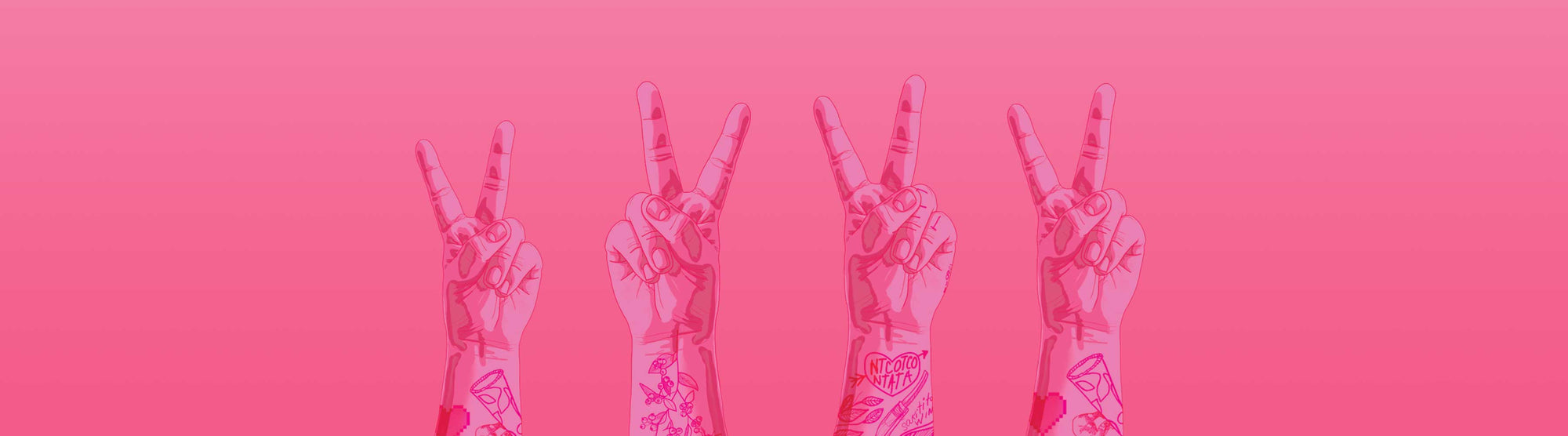
I had decided to draw my hand, and while I was working, I thought back to something my sister once told me: “We’re like recipes: a cup of Kokom, a cup of Mocom, a cup of grandma, a cup of grandpa, half a cup of dad, etc., and that’s how we’re made.” We’re all little pieces of the people in our family. It’s in our blood and we are its representatives; my skin and my DNA are made of all my ancestors. I will proudly carry this message of love and peace.
I chose Onickaniwon because the word has several meanings; it means “we wake up”. First, because it’s the first thing we do in the morning, wake up; and then, if we love coffee, we make some. If I translate onickaniwon, it’s the “act of ending the wandering; we stop being lost”. It’s consciousness waking up from a dream, from a deep sleep, from a nap or from reality. You can also use onicka to tell someone they need to open their eyes and see the truth.
What would you like to say to people who want to learn more about Indigenous peoples?
Be open-minded and take an interest in others. We also need to take the time to rewrite the true History, the one passed down by our families, their heritage. We know what happened and it must be written down, even if it’s sad for Indigenous people and embarrassing for Canada and Quebec. I remember too… Non-Indigenous people, people of colour, everyone in America: my ancestors reached out their hands to your ancestors.
* To discover Atikamekw culture: https://www.atikamekwsipi.com/
** To learn more about police violence and discrimination against Indigenous women (in French): https://liguedesdroits.ca/femmes-autochtones-police-violence-discrimination/